

 LinguaVox
 ISO 9001
 ISO 17100
 ISO 18587
Confirm the language at each stage
Ask whether visitors will speak Slovenian throughout or use English for a particular talk. Do not infer a language from nationality or substitute Slovak for Slovenian. Identify who needs to hear the presentation in Spanish and whether host questions must travel back into Slovenian. That return direction is part of the work even if an invitation refers only to the opening speech.
An event with several groups needs a room-by-room schedule. One interpreter cannot follow simultaneous discussions. Our language interpreters overview provides language guidance but does not represent a reservation. Date, topic and actual directions determine whether appropriate professionals can be confirmed. A precise brief prevents confusion from reaching the event day.
Follow a changing programme
A presentation with planned pauses may suit consecutive interpreting. Include time for each interpreted section and the questions. During a smaller site visit with frequent two-way exchanges, liaison interpreting may be more suitable. Indicate when the format changes and whether other speakers join the group.

The route affects sound. Describe noisy areas, access rules and the guide. The interpreter needs to see what is being demonstrated and hear visitors' questions. A machinery demonstration may be easier to discuss from a quieter stopping point. If visitors split into separate groups, each itinerary needs its own coverage assessment.
Tell the host whether the visitors will be able to stop for interpreted explanations at each station. Speaking while walking can make an exchange difficult to follow, especially when a group spreads out. Any protective clothing or restricted access should be flagged before the visit. This gives the organiser time to decide where the group can gather safely, how long each stop will take and how questions can be heard by everyone.
Prepare public sessions
Simultaneous interpreting may help an audience follow a continuous programme at conferences and events when a suitable team and sound system are available. Send room-by-room times, speaker language and listening needs. Audience questions can reverse the direction. A Slovenian session and an English session should not be treated as one language combination by default.
LinguaVox can assess and coordinate booths, receivers and microphones through specialist suppliers according to venue, format and availability. Tell us what the venue already supplies and who will test sound. Include microphones used for questions, not just the one on stage. Interpreters need to hear all relevant speech to convey it.
Share useful background
Send the agenda, participant names and roles, slides, terminology, figures and reference papers. “Industrial meeting” does not specify which equipment, components or decisions will arise. Our quality approach describes selection and briefing for the particular subject. Flag videos with speech and share them early so both audio and visual context can be checked.
Identify sensitive files so access can be agreed. A contract or leaflet for delegates in another language requires separate written work. An interpreter supports discussion of those papers but does not create translated copies. Communicate changes to speakers or subjects so preparation reflects the final programme.
Connect online participants
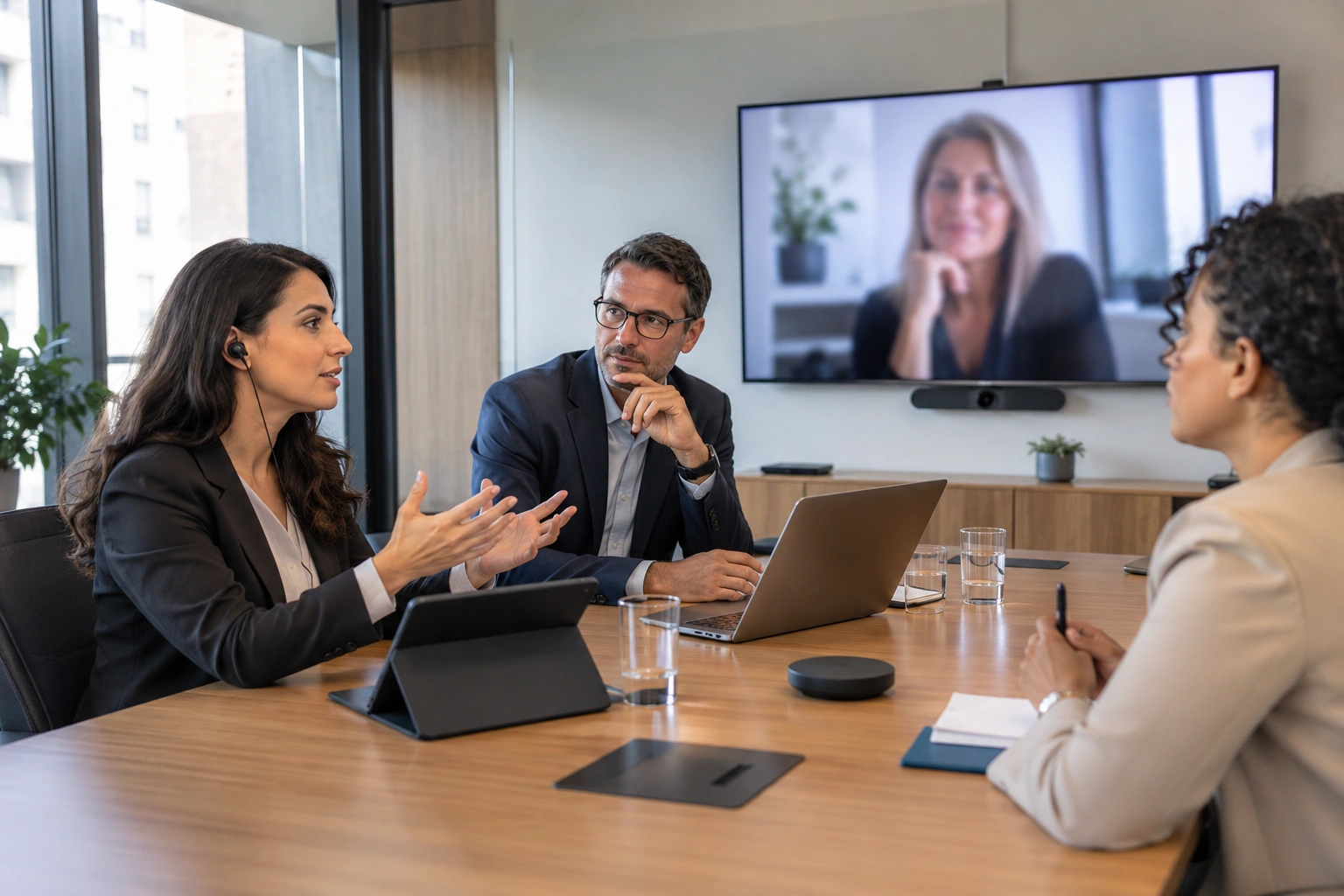
Remote interpreting can be assessed with suitable platform access, clear sound, language channels and managed turns. If visitors join remotely while several hosts sit together in Madrid, test voices across the whole room. Name the chair and agree what happens if a connection fails during a question.
For an assessment, send the date, times, venue or platform, speakers, Slovenian-Spanish directions, topic and agenda. Identify English or other languages where they occur, alongside parallel sessions and available material. Use the quote form to share a provisional programme. Availability is checked for Slovenian rather than a similarly named language.
Frequently asked questions
Are Slovenian and Slovak the same language?
No. Specify Slovenian if that is what participants choose. Ask what they will speak and hear. The professional and directions are checked explicitly.
Which method suits a site visit?
A paused presentation may use consecutive interpreting; questions on a moving tour may call for liaison. Route, noise, safety and speakers affect the choice. Share an itinerary.
Can the same team cover a talk and later meetings?
That depends on times, breaks, rooms and directions. Meetings overlapping with the talk need separate coverage. Availability must be confirmed for the full programme.
What papers should we send?
A running order, names, roles, terminology, slides and background sheets support preparation. Flag sensitive items and spoken videos. Translated documents for delegates are separate work.
Can a Slovenian meeting take place by video?
It can be assessed with suitable platform access, sound, channels and a test. The chair manages turns and questions. Tell us where participants will be and which directions are needed.