

 LinguaVox
 ISO 9001
 ISO 17100
 ISO 18587
Identify everyone who needs a language channel
List who will speak French, who will use Spanish and what each group needs to hear. A French keynote may be followed by Spanish questions requiring interpretation in the return direction. If an English-speaking guest also appears, show that part of the programme separately rather than assuming one interpreter can cover three languages. For delegates from different French-speaking countries, ask what they intend to use in the meeting instead of inferring from their origin.
Keep public sessions and private discussions distinct. A small meeting in a break may overlap with a talk that continues in another room. One professional cannot be present in both. Our language interpreters overview helps identify other languages, but a timetable by room is what allows the team to assess coverage for this event.
Bring the audience into the discussion
Simultaneous interpreting may keep continuous speeches moving at conferences and events. Planning requires speaking and listening languages, length, turns and suitable channels. Audience questions need microphones feeding the interpreters. If a question is only audible locally, delegates listening through interpretation cannot take part in the resulting exchange.
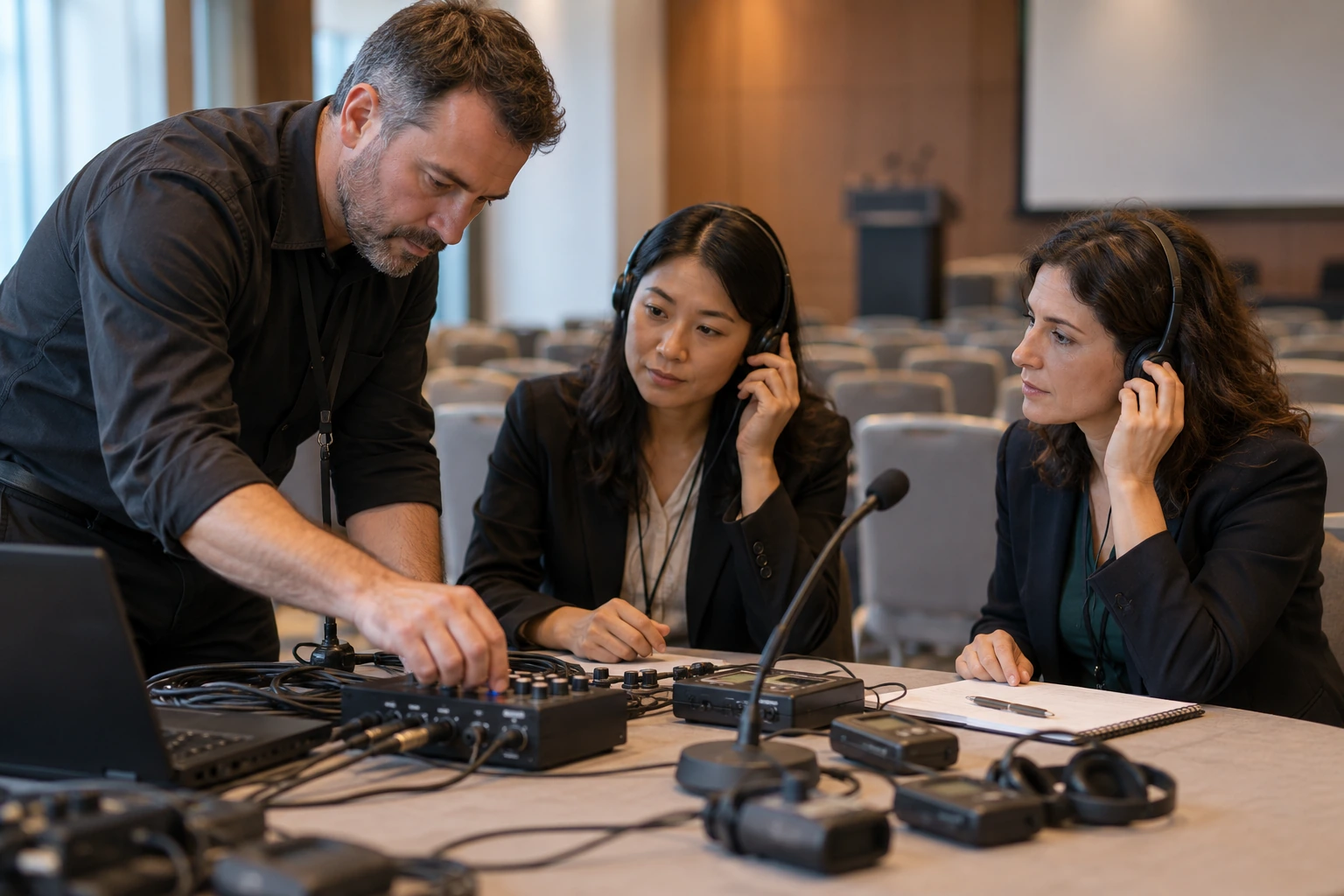
A panel may switch languages more frequently than a scripted talk. Send panellist names, the chair and the topics, and say whether responses will be in French or Spanish. Map parallel workshops room by room. Delegate numbers alone do not establish staffing; overlap and directions matter as much as audience size.
Move from formal talks to visits
A presentation with planned pauses may suit consecutive interpreting. Allow time for both the original and interpreted sections and for questions. A later exchange in a small group may call for liaison interpreting as the conversation moves in both directions. A site visit adds a route, noise, access conditions and a guide whose voice must reach the interpreter.
For a negotiation or project meeting, provide the participants' roles and the documents likely to be discussed. The interpreter conveys what each party says; they do not make decisions or certify an agreement. Written documents for delegates need their own translation scope. Explain which papers are background and which must be delivered in another language afterwards.
Brief names, figures and subject terms
A talk on research, industry or international cooperation needs more precise terminology than its headline suggests. Share a programme, names, abbreviations, slides and any useful glossary. Flag videos with speech and figures displayed only on screen. Our quality approach describes selection and preparation for a defined subject. A broad conference title cannot supply all the context needed for a specialised panel.

Identify sensitive files so access can be agreed. Revisions to the running order should reach the coordinator; a new speaker may bring a different topic or working language. If the venue needs booths or receivers, LinguaVox can assess and coordinate technical requirements with specialist suppliers according to format and availability. Equipment provision is arranged for the event rather than treated as an automatic part of interpreter attendance.
Let remote speakers be heard
Remote interpreting can be considered for a video meeting with clear audio, suitable channels and orderly turns. If panellists join a Madrid room from elsewhere, test voices from both locations and the question procedure. Shared videos need to reach the interpreter with sound. Name a chair who can respond to a dropped connection or overlapping speech.
For a proposal, send the date, duration, venue or platform, room-by-room programme, speakers, French-Spanish directions, subject and available material. Note private meetings that overlap and open decisions. Use the quote form to share a draft; format, preparation and availability can then be assessed against the real encounter.
Frequently asked questions
Can one interpreter cover talks and private meetings?
That can be assessed if they do not overlap and transitions are realistic. Provide rooms, times and directions. Simultaneous conversations need separate coverage consideration.
What if the audience asks questions in Spanish?
Include Spanish-to-French interpreting and say who must hear the answers. The chair and audio system should carry every question to the interpreter. Planning only the French-to-Spanish talk leaves the debate incomplete.
Does a panel require simultaneous interpreting?
It depends on pace, audience and whether pauses are practical. Simultaneous may suit a continuous panel; a smaller discussion may use another method. Share speakers, duration and room conditions.
What helps prepare specialist terminology?
An agenda, names, roles, abbreviations, slides and a glossary provide context. Flag spoken videos and on-screen figures. Send speaker or topic changes ahead of the event.
Can a French-speaking guest join by video?
It can be assessed with suitable platform access, channels and sound. Test the remote microphone and in-room questions. Arrange speaking turns and a chair for technical interruptions.